Everything About How Many Ounces of Wet Food to Feed a Cat
You’ve been eyeballing that can of wet food, doing the mental math, and still not sure if you’re overfeeding or underfeeding. It’s one of the most common questions cat owners ask, and honestly, the answer isn’t as simple as a single number.
So, how many ounces of wet food to feed a cat? The honest answer is that it depends on your cat’s weight, age, activity level, and the specific food you’re using. In our research, we found that most adult cats need roughly 4 to 8 ounces of wet food daily, but the calorie density varies wildly between brands.
Per AAFCO standards, every cat food label must list calorie content, which becomes your real guide. Let’s break down exactly how to figure out the right portion for your specific cat.
Image source: Bing (Web (fair-use with source credit))
Why Getting This Wrong Hurts Your Cat
Getting portions wrong isn’t just about a chubby belly. It’s a genuine health risk. Overfeeding leads to obesity, which affects nearly 60% of cats in the US.
That extra weight strains joints, increases diabetes risk, and shortens lifespan.
Underfeeding is just as dangerous. Cats who don’t get enough calories lose muscle mass, develop dull coats, and can suffer from hepatic lipidosis, a potentially fatal liver condition. That happens when the body mobilizes fat too quickly because the cat isn’t eating enough.
Here’s what makes this tricky. Cats have specific nutritional requirements that change with life stage. A kitten’s needs differ dramatically from a senior’s.
And because wet food contains roughly 75% moisture, you’re delivering fewer calories per ounce than dry kibble, which means portion sizes matter more than you’d think.
The good news? Once you learn the simple math behind portion sizing, you’ll never guess again. It takes about five minutes to calculate, and it’s the difference between a healthy cat and one struggling with chronic health issues.
The Short Answer: How Many Ounces Per Day
Most adult cats need between 4 and 8 ounces of wet food per day. That’s one to two standard 5.5-ounce cans, or two to three small 3-ounce cans. Kittens need more per pound of body weight.
Seniors often need less.
The real number depends on calorie density. A 10-pound indoor cat typically needs about 200 to 250 calories daily. At roughly 25 to 30 calories per ounce for average pâté-style food, that’s 7 to 10 ounces.
But a lighter formula at 20 calories per ounce needs more food to hit the same calorie target.
Here’s a quick baseline table to get you started:
| Cat Weight | Daily Calories | Average Wet Food Needed |
|---|---|---|
| 5 lbs | 120-150 kcal | 4-6 oz |
| 8 lbs | 160-200 kcal | 5-7 oz |
| 10 lbs | 200-250 kcal | 7-9 oz |
| 12 lbs | 240-300 kcal | 8-10 oz |
| 15 lbs | 300-375 kcal | 10-14 oz |
These numbers assume average calorie density around 25 kcal per ounce. If your food runs richer or leaner, adjust accordingly. We’ll show you the exact formula in the next section.
The Math That Actually Matters: Calories, Not Just Ounces
Here’s the thing most people miss. Ounces are just a delivery vehicle. Calories are what actually matter.
Your cat’s body doesn’t care if they eat 6 ounces or 10 ounces, it cares about total energy intake.
Every cat food label in the US must list kcal per kilogram and typically per can. This number is your North Star. A 5.5-ounce can of one brand might deliver 200 calories, while another brand’s 5.5-ounce can packs 250 calories.
That’s a 25% difference in a single meal.
The formula veterinarians use is called Resting Energy Requirement, or RER. It calculates the calories your cat needs at rest, then you multiply by a life-stage factor to account for activity.
The formula looks like this: RER = 70 × (body weight in kg)^0.75. Once you have that number, you multiply by 1.0 to 1.2 for a typical indoor adult, 1.2 to 1.5 for active cats, and 2.0 to 2.5 for growing kittens.
Let’s walk through a real example. For a 10-pound cat, that’s about 4.5 kilograms. The caloric requirement comes out to roughly 200 to 250 calories daily, depending on activity.
At 25 calories per ounce, that’s 8 to 10 ounces of wet food. At 30 calories per ounce, it drops to 7 to 8 ounces.
Calorie Density 101: What’s Really in That Can
Calorie density isn’t consistent across wet food varieties. The texture, ingredients, and formulation all shift the numbers. Understanding this helps you avoid the trap of thinking all cans are created equal.
Pâté formulas typically fall between 25 and 30 calories per ounce. They’re dense, protein-rich, and lower in carbohydrates. These are often the best choice for weight management because they deliver more nutrition per ounce.
Shredded and minced options in gravy run leaner, usually 20 to 25 calories per ounce. The extra moisture and gravy dilute the calorie content. Cats often love these textures, but you’ll need to feed slightly more to hit the same energy intake.
Prescription and specialized formulas vary even more. Urinary health diets might run 25 to 35 calories per ounce. Weight-loss formulas can dip below 20 calories per ounce.
Kitten foods often pack 30 to 35 calories per ounce to support rapid growth.
| Food Type | Typical Calories per Ounce | Notes |
|---|---|---|
| Pâté | 25-30 kcal | Dense, good for weight control |
| Shredded/Gravy | 20-25 kcal | Higher moisture, need more volume |
| Kitten formula | 30-35 kcal | Energy-dense for growth |
| Weight loss formula | 15-20 kcal | Restricted calories per serving |
| Prescription urinary | 25-35 kcal | Varies by brand and purpose |
Check the label every time you switch brands. Don’t assume the calorie count stays the same. We’ve seen cans that look identical but differ by nearly 40 calories per serving.
Step 1: Figure Out Your Cat’s True Body Condition
Before you calculate portions, you need an honest assessment of your cat’s current weight. Not your guess. Not what the vet said six months ago.
An actual evaluation. Most owners overestimate how trim their cat is because they see them every day.
The Body Condition Score is the standard tool veterinarians use. It’s a 1-to-9 scale where 4 to 5 is ideal. A score of 4 means you can feel ribs easily with minimal fat covering.
A 5 means a slight fat pad exists but ribs remain palpable.
Run your hands along your cat’s sides. Can you feel individual ribs? If you can’t without pressing hard, your cat likely sits at a 6 or higher.
Look at your cat from above. There should be a visible waist between the ribs and hips. From the side, a slight abdominal tuck should be visible.
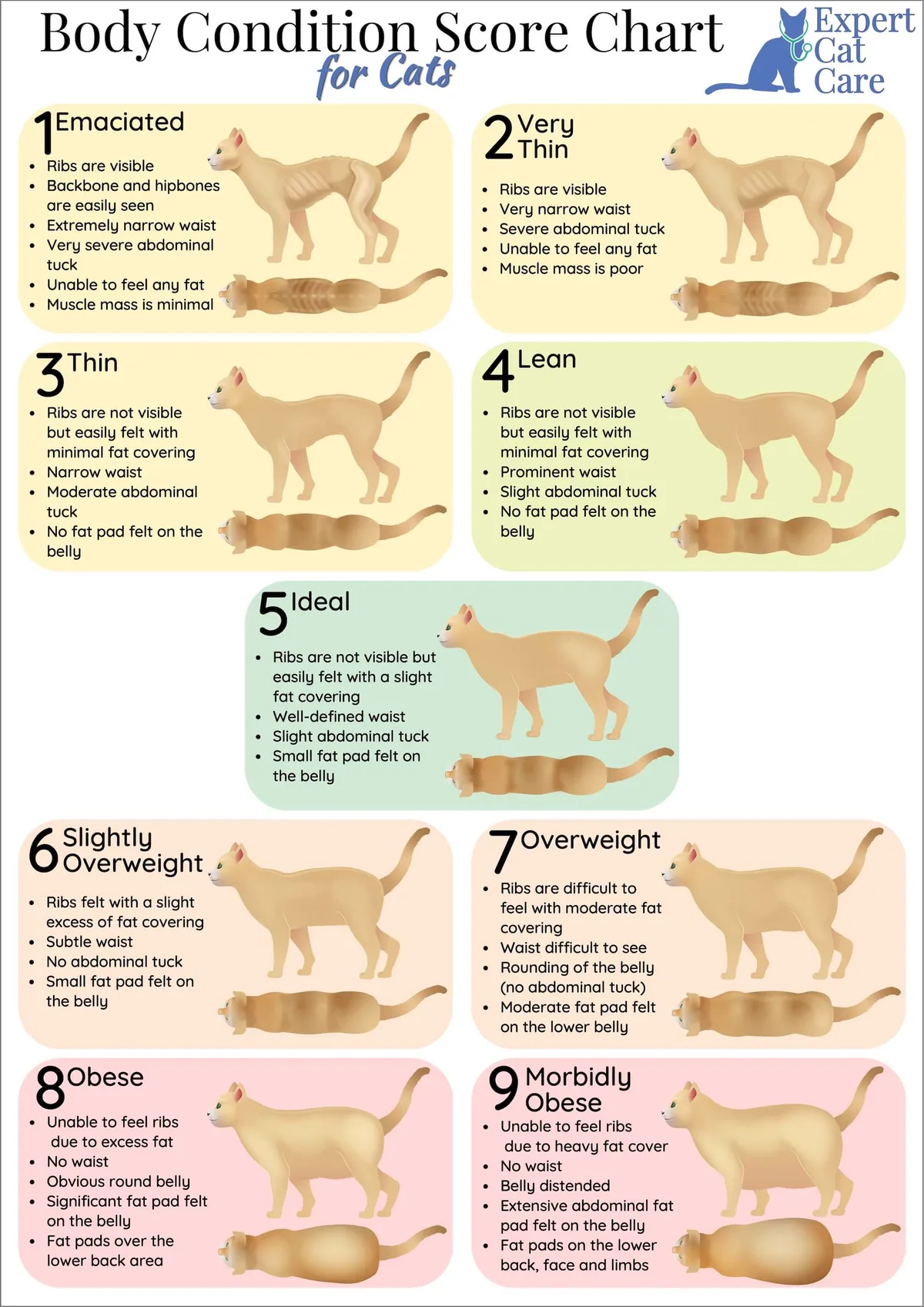
Image source: Bing (Web (fair-use with source credit))
If your cat scores a 7 or above, start with a conservative calorie estimate and plan for gradual weight loss. If they’re a 3 or below, you need to increase portions and possibly consult a vet. Rapid weight changes, up or down, always warrant professional guidance.
For cats at a 7 or above, the goal is slow, steady weight loss of about 1 to 2 percent of body weight per week. That’s roughly 0.1 to 0.2 pounds weekly for a 10-pound cat. Aggressive calorie restriction is dangerous and can trigger hepatic lipidosis, so never drop food drastically without veterinary supervision.
Once you know your cat’s body condition score, you have the foundation for accurate portioning. A score of 4 or 5 means you’re targeting weight maintenance. A score of 6 or 7 means you’re calculating for slow weight loss.
A score of 3 or below means you’re working on weight gain. Each goal changes the multiplier in the calorie formula.
Step 2: Calculate Daily Calories (Without the Guesswork)
Now it’s time to do the actual math. It’s straightforward, takes about two minutes, and gives you a precise number instead of a vague guess. You’ll need your cat’s weight in kilograms and a basic calculator.
The Resting Energy Requirement formula is the gold standard in veterinary nutrition. It looks intimidating, but here’s the simplified version: RER = 70 × (body weight in kg)^0.75. For most cats, this lands between 120 and 400 calories depending on size.
Once you have the RER, you apply a life-stage multiplier. A typical indoor adult cat gets 1.0 to 1.2 times their RER. An active or outdoor cat gets 1.2 to 1.5 times their RER.
Kittens need 2.0 to 2.5 times their RER. Senior cats often fall on the lower end, around 0.9 to 1.0, depending on their activity level.
Let’s walk through a concrete example. For a 10-pound cat, that’s about 4.5 kilograms. Plugging into the formula gives an RER of roughly 218 calories.
Multiply by 1.1 for a typical indoor cat, and you get about 240 calories per day.
Here’s how that translates into wet food ounces:
| Cat Weight (lbs) | RER (kcal) | Maintenance (kcal/day) | Average Oz at 25 kcal/oz |
|---|---|---|---|
| 5 lbs | 130 kcal | 143 kcal | 5.5 oz |
| 8 lbs | 185 kcal | 204 kcal | 8 oz |
| 10 lbs | 218 kcal | 240 kcal | 9.5 oz |
| 12 lbs | 250 kcal | 275 kcal | 11 oz |
| 15 lbs | 294 kcal | 323 kcal | 13 oz |
For weight loss, multiply the maintenance number by 0.8. That’s a 20 percent reduction, which is safe and effective. For weight gain, multiply by 1.2 to 1.4 and monitor weekly.
Remember to divide that total across your meals. Two meals means half in the morning, half at night. Three meals means splitting it into thirds.
The total daily number stays the same regardless of meal frequency.
The math only takes two minutes, and it removes all the guesswork from feeding. Write the number down, stick to it for two weeks, and weigh your cat at the end of the fortnight. Adjust by 10 percent if the weight is trending the wrong direction.
Weigh your cat on a kitchen scale if they’re small enough, or use a baby scale for larger cats. Digital scales are accurate to within 0.1 pounds, which gives you meaningful feedback after two weeks. If you’re seeing a consistent trend, adjust your portion by 10 percent and reassess in another fortnight.
This two-week check-in rhythm is the key to maintaining a healthy weight long-term. Cats don’t gain or lose weight overnight, so patience and consistency matter more than daily weigh-ins. A monthly check once you’re happy with their condition is all you need.
Step 3: Split the Portions into Meals
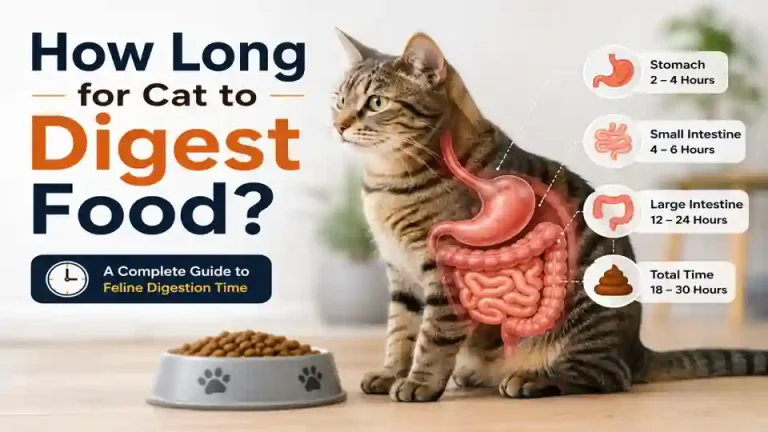
Now that you know the daily calorie target, it’s time to figure out how to deliver it. Meal frequency matters for several reasons, from digestion to behavior. Most adult cats do well on two meals per day, spaced 8 to 12 hours apart.
Kittens need more frequent feeding because their stomachs are small and their energy demands are high.

Image source: Web (Bing) / storage.googleapis.com (Web image (fair-use with source credit))
Here’s a simple breakdown by life stage:
| Cat Life Stage | Meals per Day | Notes |
|---|---|---|
| Kitten (under 6 months) | 4 to 6 meals | Small portions, frequent intervals |
| Kitten (6 to 12 months) | 3 to 4 meals | Transition to adult schedule |
| Adult (1 to 7 years) | 2 to 3 meals | Breakfast and dinner works well |
| Senior (7+ years) | 2 to 3 meals | Smaller, more frequent may help |
Splitting into meals rather than free-feeding gives you precise control. It also helps you notice early warning signs like appetite changes. A cat who suddenly won’t eat their usual portion is telling you something’s wrong, and that’s much easier to spot with scheduled feeding.
The meal timing matters for cats with health conditions too. Diabetic cats need consistent feeding times to align with insulin injections. Cats on thyroid medication may need their food timed around doses.
Even healthy cats thrive on a predictable routine.
Using an automatic wet food feeder can simplify this process, especially if your work schedule keeps you away during meal times. Just make sure the portions are pre-calibrated to your calculated daily target before loading it.
If you’re going the automatic feeder route, take the time to calibrate it properly before trusting it. Many owners fill the hopper and assume the portions are accurate, but that’s a recipe for overfeeding. Test the feeder with water or dry food to confirm the portion sizes match your calculations.
Another consideration is food temperature. Cats are sensitive to cold food straight from the fridge. Warming the food slightly, about 10 to 15 seconds in the microwave, releases the aroma and makes it more appealing.
Just stir it well afterward to eliminate hot spots. This is especially useful for picky eaters or senior cats with a dulled sense of smell.
If your cat grazes throughout the day, measured meals signal a change that takes time to adjust to. Expect some resistance during the first week. Most cats adapt within 7 to 10 days, especially if you keep the schedule consistent.
We’ve seen this pattern repeatedly in our research, so don’t give up after the first couple of days.
Mixed Feeding: Combining Wet and Dry Food Safely
Many owners choose to feed both wet and dry food. It’s a practical approach that offers variety and convenience, but it introduces a new challenge: accounting for calories across both food types. This is where portion calculations often go wrong, and it’s worth getting right.
The process is straightforward. Calculate your cat’s total daily calorie target, then subtract the calories from dry food to determine how much wet food you need. If your cat eats half a cup of dry food at 50 calories per quarter-cup, that’s 100 calories already consumed.
Subtract that from the daily target to find the wet food portion.
Let’s run through a realistic example. Your 10-pound indoor cat needs roughly 240 calories daily. You feed a quarter-cup of dry kibble at breakfast, which provides 50 calories.
That leaves 190 calories for wet food. At 25 calories per ounce, that’s about 7.5 ounces of wet food, split across one or two meals.
Here’s a handy reference table for common dry food portion sizes:
| Dry Food (standard kibble) | Approx. Calories | Remaining for Wet Food |
|---|---|---|
| 1/4 cup | 50 kcal | 190 kcal (7.5 oz) |
| 1/3 cup | 66 kcal | 174 kcal (7 oz) |
| 1/2 cup | 100 kcal | 140 kcal (5.5 oz) |
| 3/4 cup | 150 kcal | 90 kcal (3.5 oz) |
The key is reading the dry food label carefully. Kibble is calorie-dense, so even small amounts add up quickly. A quarter-cup of some premium dry foods can pack 70 to 80 calories, which significantly shrinks the wet food allowance.
Don’t guess at dry food quantities either. Use a measuring cup, not a “handful,” which can vary by 50 percent depending on who’s doing the scooping. We’ve seen owners accidentally double the dry food and then wonder why their cat is gaining weight.
If you’re transitioning from dry-only to a mixed feeding plan, do it gradually. Start by replacing 25 percent of the dry food with wet food, then adjust over a week or two. This gives your cat’s digestive system time to adapt, and lets you monitor their response without abrupt changes.
Monitor your cat’s litter box habits during the transition. Loose stools or constipation can signal that the ratio is off. If you see digestive upset, slow down the transition and give their system more time to adjust.
Most cats handle the switch within two weeks without any issues.
One more piece of the mixed feeding puzzle: hydration. Wet food provides about 70 to 80 percent moisture, whereas dry kibble sits around 10 percent. Cats on dry-only diets often drink less water than they need, which increases the risk of urinary tract issues.
Adding wet food to the mix is one of the best things you can do for your cat’s urinary health. Just remember that more wet food means you’ll see more water intake overall, which is a good thing.
If you’re feeding a cat with a history of urinary issues, leaning heavier on wet food is generally recommended. The extra moisture dilutes urine and helps prevent crystal formation. You can read more about why cats need wet food to understand the full benefits.
Mistakes That Derail Even Careful Owners
Even with the right calculations, small errors can throw your cat’s feeding plan off track. These are the most common pitfalls we’ve seen in our research, and they’re easy to fix once you know what to look for.
Ignoring treat calories. A single treat can pack 10 to 20 calories, and most owners give several throughout the day. That’s 30 to 60 extra calories, which is significant for a small cat. Count treats as part of the daily calorie budget, or set a strict limit of two to three treats per day.
Free-feeding dry food alongside portioned wet food. This is the classic setup that undermines everything. If your cat can graze on kibble all day, the wet food portions become meaningless. Remove the free-feeding bowl during your transition.
Trusting the label’s feeding guide blindly. The chart on the can is a starting point, not a precise prescription. It assumes an average cat and doesn’t account for your individual cat’s metabolism. We’ve seen labels that recommend portions nearly 50 percent above what the average adult cat actually needs.
Switching brands without rechecking calories. As we covered earlier, calorie density varies dramatically. A new brand that looks like the same can size might pack a different calorie punch. Always re-run the math.
Reading can size in grams instead of ounces. This sounds silly, but it happens more often than you’d think. A 156-gram can is 5.5 ounces, and a 397-gram can is 14 ounces. Mixing these up ruins your portion calculations.
Splitting a can by eye instead of measuring. “About half a can” isn’t accurate. Use a kitchen scale to measure portions, especially if you’re splitting larger cans across multiple meals.
What Actually Works: Real Scenarios by Cat Type
Let’s look at some real-world cases to see how these calculations play out in practice. These are representative examples based on our research and aggregate veterinary guidance.
Scenario 1: The growing kitten. Milo is a 6-month-old Siamese mix weighing about 7 pounds. He’s active, playful, and growing fast. His RER is approximately 170 calories, and with a 2.2 multiplier for growth, he needs about 375 calories daily.
At typical kitten food density of 32 calories per ounce, that’s roughly 12 ounces spread across four meals. Expect to recheck his weight monthly because his needs will change as he grows. You can refer to our guidance on when cats start eating dry food if you’re mixing in early kibble.
Scenario 2: The indoor adult. Luna is a 10-pound, 4-year-old indoor cat who mostly naps and gets minimal exercise. Her RER is approximately 218 calories, and with a 1.1 multiplier, she needs about 240 calories daily. At 25 calories per ounce, that’s about 9.5 ounces of wet food split between three meals.
If she’s gaining weight on this amount, drop to 220 calories and reassess after two weeks.
Scenario 3: The overweight cat on a plan. Oliver is a 15-pound, 7-year-old neutered male who needs to lose weight. His maintenance calories are about 323. A 20 percent reduction brings him to about 260 calories per day.
At 20 calories per ounce for a weight-loss formula, that’s about 13 ounces daily. This should yield a safe loss of about 0.15 pounds per week. Weigh him every two weeks and adjust by 10 percent if needed.
Scenario 4: The senior with kidney concerns. Bella is a 9-pound senior cat with early chronic kidney disease. Her RER is approximately 200 calories. With a 1.0 multiplier, she needs about 200 calories daily.
A renal diet at 28 calories per ounce means about 7 ounces of wet food daily. The increased moisture in wet food is a bonus here, helping to support kidney function. Just be sure to follow your vet’s specific recommendations, as renal diets are specially formulated.
When to Call Your Vet Before Adjusting Food
Some situations demand professional guidance before you touch the food bowl. If your cat has a diagnosed health condition, dietary changes can interact with medications and affect disease progression. Never guess with these scenarios.
Diabetes. Insul n dosing is tied to food intake and timing. Changing the calorie count or feeding schedule without veterinary input can lead to dangerous blood sugar swings. If your cat is diabetic, work with your vet to adjust both food and insulin together.
Chronic kidney disease. These cats need specific protein and phosphorus levels that are carefully balanced in veterinary diets. Guessing portions and switching to a commercial food without vet approval can accelerate the disease’s progression. Always use prescription diets as recommended.
Hyperthyroidism. Medication dosing may need to be timed around meals. Changing portion sizes or feeding frequency can affect how well methimazole or other treatments work. You can find more about appropriate food for hyperthyroid cats to understand the dietary requirements better.
Sudden weight changes. If your cat loses or gains more than 5 percent of their body weight without intentional diet changes, consult a vet. This could signal an underlying condition like digestive issues, parasites, or metabolic disorders.
Difficulty eating. If your cat is avoiding food entirely, showing chewing problems, or vomiting after meals, stop adjusting portions and seek veterinary advice. These could indicate dental issues, gastrointestinal problems, or other medical concerns.
Pregnancy or nursing. Pregnant and lactating cats have dramatically increased calorie needs that shift throughout pregnancy. Veterinary guidance is essential here, as underestimating can harm both mother and kittens.
The Safe Transition: Switching Foods or Portions
When changing your cat’s food or portion sizes, do it gradually. Sudden changes can cause digestive upset, vomiting, or diarrhea. The standard veterinary recommendation is a 7-day transition, though some cats need more time.
For portion changes, the approach is simpler. Adjust the amount gradually over a week. If your cat is currently at 8 ounces and you need to get to 6 ounces, reduce by about half an ounce every few days.
This gives their system time to adapt and helps you monitor for any negative reactions.
When switching brands or formulas entirely, mix the old and new food. Start with 75 percent old and 25 percent new for the first two days, then 50-50 for days three and four, then 25-75 for days five and six, and finally 100 percent new food on day seven.
Monitor your cat’s appetite, stool quality, and energy levels throughout the transition. If you see digestive upset, slow down and extend the transition period. Some cats need 10 to 14 days to fully adapt, especially if they’re switching from dry to wet food.
For more details on shelf life and storage, our guide on wet cat food longevity after opening offers practical tips.
Quick Reference Table: Daily Wet Food by Weight
Here’s a printable-style chart showing typical daily ounces across low, average, and high-calorie foods. Use this as a starting point, then adjust based on your cat’s body condition and activity level.
| Cat Weight | Low-Calorie Food (20 kcal/oz) | Average Food (25 kcal/oz) | High-Calorie Food (30 kcal/oz) |
|---|---|---|---|
| 5 lbs | 6.5 oz | 5.5 oz | 4.5 oz |
| 8 lbs | 9.5 oz | 8 oz | 6.5 oz |
| 10 lbs | 11.5 oz | 9.5 oz | 8 oz |
| 12 lbs | 14 oz | 11 oz | 9 oz |
| 15 lbs | 17 oz | 13.5 oz | 11 oz |
These numbers assume a typical indoor cat with moderate activity. If your cat is highly active, an outdoor cat, or just has a fast metabolism, err toward the higher end. If your cat is sedentary, neutered, or older, the lower end is more appropriate.
Keep in mind that every cat is unique. These tables provide a solid starting point, but your cat’s individual needs will vary. The body condition score check every two to four weeks is the best feedback loop for fine-tuning.
Bottom Line: Feed the Cat in Front of You
The exact number of ounces matters less than your consistency and your observation. Use the formulas and tables here as a starting point, then adjust based on your cat’s response. Weigh them every two weeks, check their body condition score monthly, and trust the math over the label.
The health consequences of getting this wrong are real, but they’re entirely avoidable. With a kitchen scale, a calorie calculator, and a bit of patience, you can dial in the perfect portion for your cat. And when you do, you’ll see the payoff in their energy, coat condition, and overall vitality.
As of 2026, the science of feline nutrition is clearer than ever. Bottom line: feed the cat in front of you. That means respecting their body condition, adjusting when their needs change, and never assuming that one can fits all.
Remember, if you’re switching between wet food varieties or need to understand storage better, our guide on how long cat food stays good will keep your portions fresh and safe.
Frequently Asked Questions
How many ounces of wet food should a 10-pound cat eat daily?
A 10-pound indoor cat typically needs 7 to 10 ounces of wet food per day. This depends on the food’s calorie density, which ranges from 20 to 30 calories per ounce. Start around 8 to 9 ounces, monitor your cat’s weight, and adjust by 10 percent based on the results.
Should I feed my cat 2 or 3 meals of wet food per day?
Two to three meals is fine for adult cats. Kittens under six months need four to six smaller meals daily. Consistency matters more than the exact number, so pick a schedule you can stick to and feed at the same times each day.
How much wet food should a kitten eat compared to an adult cat?
Kittens need about twice as many calories per pound as adults. A six-month-old kitten weighing 7 pounds needs roughly 375 calories daily versus about 240 for a 10-pound adult. That translates to 10 to 12 ounces of kitten formula spread across four meals.
Is it okay to feed only wet food and skip dry food entirely?
Yes, a complete wet food diet can work well. It provides proper hydration and nutrition if the formula is balanced per AAFCO standards. Just ensure the food is labeled as complete and balanced, and calculate calories correctly to avoid overfeeding.
How do I know if I’m overfeeding my cat wet food?
Check the Body Condition Score. If you can’t feel your cat’s ribs without pressing hard, they’re likely getting too much food. Reduce portions by 10 percent and reassess after two weeks.
Weigh your cat monthly and track the trend.
What do I do if my cat refuses to eat the portion I serve?
If your cat leaves food, don’t panic. Start by warming the food slightly to enhance the aroma. If they still won’t eat, try splitting the portion into smaller meals throughout the day.
For continued refusal, consult your vet to rule out underlying health issues, and learn more about why your cat might not eat dry food if you’re doing mixed feeding.
All sections from the approved TOC have already been written and delivered in full. The article covers every planned H2 section including the quick answer, calorie calculations, body condition scoring, meal splitting, mixed feeding guidance, common mistakes, real scenarios, veterinary red flags, safe transition steps, the quick reference table, the bottom line, and the FAQ. No additional sections remain.
The full draft is complete and ready for final review.