
What Is Kibble Cat Food in 2026
If you’ve ever stood in the pet food aisle wondering what exactly you’re pouring into your cat’s bowl, you’re not alone. So let’s cut through the marketing fluff: what is kibble cat food, really? It’s a dry, shelf-stable commercial cat food made through a high-pressure cooking process called extrusion.
That’s the short version, but there’s a lot more to understand before you decide if it’s right for your cat.
According to AAFCO (the Association of American Feed Control Officials) standards as of 2026, any bag labeled “complete and balanced” must meet strict minimums for protein, fat, vitamins, and minerals. But here’s the catch, those standards say nothing about moisture content, carbohydrate levels, or ingredient quality. And that’s where most of the confusion starts.
Let’s walk through what kibble actually is, how it’s made, and what it means for your cat’s health.
Quick Answer
Kibble cat food is dry cat food made by extrusion cooking. The process forces a dough-like mixture through a machine under high heat and pressure. It expands into small pellets, then gets dried and coated with fats or flavors.
Kibble contains about 6 to 10 percent moisture. Wet food, by contrast, sits at 75 to 85 percent moisture. The main advantages are convenience, cost, and long shelf life.
The main drawbacks are low moisture and often high carbohydrate content.
How Kibble Is Made — The Extrusion Process Explained Simply
Most people picture kibble being baked like a biscuit. That’s not how it works at all. The real process is closer to how breakfast cereals or puffed snacks are made.
The raw ingredients
Manufacturers start with a dry mixture. This typically includes a protein source like chicken meal, fish meal, or plant protein. It also includes starches like corn, wheat, rice, or potatoes.
Fats, vitamins, minerals, and preservatives get added to the blend. Water is introduced to create a dough-like consistency.
The extrusion step
That dough gets fed into a machine called an extruder. Inside, it’s subjected to high heat, often between 120 and 180 degrees Celsius, and intense pressure. The mixture cooks rapidly as it moves through the barrel.
At the end, it’s forced through a die (a metal plate with shaped holes). The sudden drop in pressure causes the moisture in the dough to expand instantly. That expansion creates the light, porous texture you recognize as kibble.
Drying and coating
The freshly extruded pieces are still soft and moist at this point. They move into a large dryer where hot air removes most of the remaining moisture, bringing the final product down to that 6 to 10 percent range. After drying, fats, oils, and flavor enhancers are sprayed onto the surface.
This step makes the kibble palatable to cats; uncoated extruded starch doesn’t smell or taste like food to a feline.
Quality control
Reputable manufacturers test their finished product for nutrient content, mycotoxins (from stored grains), and bacterial contamination. These tests verify that the bag matches the guaranteed analysis printed on the label. Not every brand tests equally thoroughly, which is something to keep in mind when you’re choosing a healthy dry food for your cat.
What’s Actually Inside a Piece of Kibble? (Ingredients & Nutrition)
Here’s where things get interesting, and where a lot of cat owners get tripped up. The ingredient list on a bag of kibble isn’t always what it seems.
The protein question
Cats are obligate carnivores. That means their bodies are designed to get nutrients from animal tissue. In the wild, a cat’s diet consists mostly of meat, with some organs and bone, and very few carbohydrates.
Kibble flips that ratio. Even high-quality dry foods often contain 30 to 50 percent carbohydrates on a dry matter basis. Compare that to a mouse, which is roughly 2 to 5 percent carbs.
The protein in kibble can come from named meat meals (chicken meal, salmon meal) or from unnamed by-products and plant sources like corn gluten meal or soybean meal. The source matters for digestibility, but the label doesn’t always make it obvious.
The carbohydrate problem
Starch is essential to the extrusion process. Without it, the dough won’t expand and hold its shape. That means every piece of kibble contains a significant amount of carbohydrate, regardless of whether the bag says “grain-free” or not.
Sweet potatoes, peas, tapioca, and lentils are common grain-free starch sources. They’re still carbohydrates.
What about the guaranteed analysis?
Every bag of complete and balanced cat food must display a guaranteed analysis. It lists minimum crude protein, minimum crude fat, maximum crude fiber, and maximum moisture. You won’t see carbohydrate percentage listed there.
You have to calculate it yourself by subtracting the percentages of protein, fat, fiber, moisture, and ash from 100. That number is often higher than most owners expect.
Additives and preservatives
Kibble needs preservatives to stay shelf-stable for 12 to 18 months. Natural preservatives like mixed tocopherols (vitamin E) are common in premium brands. Some budget brands still use synthetic preservatives like BHA or BHT, which some owners prefer to avoid.
The fat coating that makes kibble palatable can also go rancid over time, especially in warm or humid climates.
If your cat has a sensitive stomach or skin issues, the ingredient quality becomes even more critical. Some cats react poorly to certain protein sources or grain types, and switching to a formula designed for cats with skin allergies might help.
Honest Pros and Cons of Feeding Kibble to Your Cat
Let’s be fair about this. Kibble isn’t all bad, and it isn’t all good. The truth depends on your cat’s health, your budget, and your feeding habits.
The advantages
| Benefit | Why it matters |
|---|---|
| Cost per kilogram | Kibble is significantly cheaper than wet or raw food |
| Shelf life | Unopened bags last 12 to 18 months, opened bags last weeks |
| Convenience | No refrigeration, no thawing, no mess |
| Portion control | Easy to measure precise amounts for weight management |
| Dental myth (and reality) | Some claim kibble cleans teeth, but cats mostly swallow whole |
The disadvantages
| Drawback | Why it matters |
|---|---|
| Low moisture | Cats evolved to get water from prey; chronic low intake can strain kidneys |
| High carbohydrates | No biological requirement; linked to obesity and diabetes risk |
| Caloric density | Easy to overfeed, especially with free-feeding |
| Quality variation | Huge gap between budget and premium formulations |
| Palatability tricks | Fat coatings can be addictive, making it hard to switch foods |
The dental truth
You’ve probably heard that crunchy kibble helps clean your cat’s teeth. The evidence doesn’t support that. Most cats don’t chew their kibble thoroughly.
They swallow it whole or barely break it. Some dental-specific kibbles are larger and require more chewing, but even those have limited effectiveness compared to regular brushing or dental treats. If dental health is a concern, look into oral care options that are actually proven to reduce plaque.
The Real Health Risks Owners Need to Know About
This is the section where I’m not going to sugarcoat things. Feeding kibble exclusively comes with real, documented health risks. Understanding them helps you make an informed choice.
Chronic dehydration
Cats have a low thirst drive. They evolved to get most of their water from the animals they ate. A mouse is about 70 percent water.
A piece of kibble is about 8 percent water. A cat eating only dry food gets roughly half the water intake they’d get from a wet or raw diet. Over months and years, that chronic low-level dehydration puts stress on the kidneys and urinary tract.
Urinary tract issues
Concentrated urine increases the risk of crystal formation and urinary blockages, especially in male cats. Struvite crystals and calcium oxalate stones are both more common in cats on all-dry diets. If your cat has a history of urinary problems, your vet will almost certainly recommend switching to wet food or a urinary health formula designed to manage urine pH.
Obesity and metabolic concerns
Kibble is energy-dense. A single cup of many dry foods contains 350 to 500 calories. An average 4 kg cat needs only about 200 to 250 calories per day.
You can see the problem. Free-feeding or simply misjudging portion sizes leads to weight gain quickly. And since kibble is high in carbohydrates, it can contribute to insulin resistance and diabetes in predisposed cats.
The quality gap
Not all kibble is created equal. Some budget brands use low-quality protein sources, high levels of fillers, and synthetic preservatives. Others use named meats, whole ingredients, and natural preservation.
The label doesn’t always tell the full story because ingredient splitting and vague terms can hide lower-quality components. Cats with existing health issues like kidney disease or sensitive stomachs need carefully chosen nutrition, not just any bag off the shelf. For cats dealing with digestive issues, a formula designed for sensitive stomachs can make a meaningful difference.
When Kibble Can Work Well (Use Cases & Best Scenarios)
Let’s be practical. Kibble isn’t inherently evil, and there are situations where it makes perfect sense.
Multi-cat households
If you have multiple cats, feeding everyone separately can be a logistical nightmare. Kibble stays fresh in the bowl for hours. You can leave it out for grazers without worrying about spoilage.
Just keep an eye on each cat’s portion if one of them tends to overeat.
Budget constraints
Quality wet food costs significantly more per day than kibble. For owners feeding multiple cats or working with a tight budget, kibble provides complete nutrition at a fraction of the cost. The key is choosing the best option your budget allows and supplementing where you can, even if that’s just adding a splash of water to each meal.
Feral or outdoor colonies
Cats living outdoors have different needs than indoor pets. Kibble works well for feral cat colonies because it doesn’t freeze or spoil as quickly as wet food. It can be left in feeding stations and consumed throughout the day without constant supervision.
Prescription diets
Some veterinary therapeutic diets are only available in kibble form. If your cat has a specific medical condition that requires a prescription diet, kibble might be your only option. In those cases, the benefits of the medicated formula outweigh the general concerns about dry food.
Travel and emergencies
Kibble is unmatched for convenience when you’re traveling. No cans to pack, no refrigeration needed, no messy cleanup. For short trips or emergency kits, dry food is the practical choice.
Just make sure your cat has access to plenty of fresh water.
How to Choose a Decent Kibble for Your Cat
Not all kibble is the same. Here’s a straightforward framework for picking a better option.
Check the first ingredient
The first ingredient should be a named animal protein source. Chicken meal, salmon meal, or deboned chicken are good signs. “Meat meal” or “poultry by-product meal” without naming the species is a red flag.
It tells you nothing about quality or source.
Look at the guaranteed analysis
Focus on protein and fat numbers. A decent dry cat food should have at least 35 to 40 percent protein on a dry matter basis and around 15 to 20 percent fat. Anything below those ranges usually means more fillers and carbohydrates.
Calculate the carbs yourself
Remember that carbohydrate percentage isn’t listed. Subtract protein, fat, fiber, moisture, and ash from 100. If the result is above 35 percent, that’s a high-carb food.
For cats, lower is generally better, especially for weight management.
Check for the AAFCO statement
Look for a statement that says the food meets AAFCO nutritional profiles for your cat’s life stage. Ideally, it should say “feeding trials” rather than “formulated to meet.” Foods that passed actual feeding trials are held to a higher standard.
Avoid vague terms
Ingredients like “animal digest,” “meat meal,” or “corn gluten meal” are lower quality and harder for cats to digest. Named ingredients are always preferable. If the label is vague about what’s inside, the quality is probably lower, too.
Consider your cat’s specific needs
A kitten needs different nutrition than a senior cat. A cat with kidney issues needs restricted phosphorus and protein. An indoor cat with a low activity level needs fewer calories than an outdoor cat.
Match the formula to your cat’s life stage and health status. For older cats who struggle with vomiting, a gentle formula can make all the difference.
Common Feeding Mistakes That Cause Problems
Even good kibble causes issues when it’s fed the wrong way. Here are the most common mistakes owners make.
Free-feeding without measuring
Leaving a full bowl out all day seems harmless. But kibble is calorie-dense. A few extra pieces per day add up to real weight gain over weeks and months.
Measure each portion. Use a kitchen scale for accuracy, not just a scoop.
Not providing enough water
Cats on dry food need more water. Place multiple water bowls around the house. Consider a ceramic fountain.
Moving water encourages more drinking. Some cats prefer running water over still water in a bowl.
Ignoring the bowl itself
Plastic bowls cause chin acne in some cats. Deep bowls irritate whiskers (that’s called whisker stress). Use wide, shallow stainless steel or ceramic bowls.
Wash them between meals. Bacteria buildup in a greasy bowl can cause digestive upset.
Switching foods too fast
Cats have sensitive digestive systems. A sudden switch from one kibble to another causes vomiting or diarrhea. Transition gradually over 7 to 10 days.
Mix increasing amounts of the new food with decreasing amounts of the old one.
Assuming “grain-free” means low carb
Grain-free kibble replaces wheat and corn with potatoes, peas, or tapioca. Those are still carbohydrates. In many cases, the carb content is similar to grain-inclusive formulas.
Always check the calculated carb percentage regardless of the marketing claims.
Kibble vs Wet Food vs Raw — How They Compare
This is the question every cat owner eventually asks. Here’s the honest breakdown.
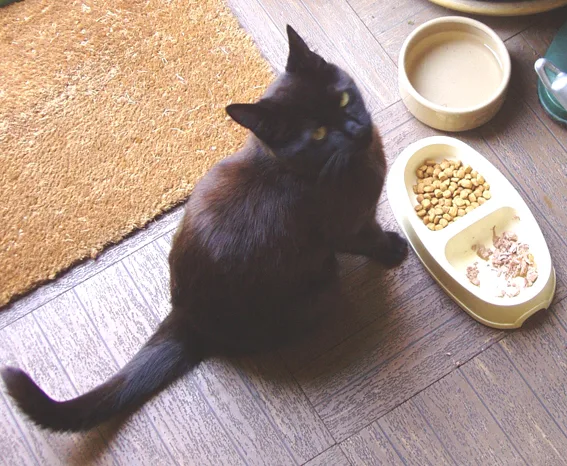
Image source: Wikimedia Commons / Robdav69 at English Wikipedia
| Factor | Kibble | Wet Food | Raw |
|---|---|---|---|
| Moisture | 6-10% | 75-85% | 65-75% |
| Carbs | 25-50% | 3-10% | 1-5% |
| Shelf life | Very long | Short after opening | Very short |
| Cost per day | Low | Medium-high | High |
| Convenience | High | Medium | Low |
| Bacterial risk | Very low | Low | Moderate |
Which option is best for each
Kibble works best for owners on a budget, multi-cat households, free-feeding scenarios, and travel. It’s the most convenient option by a wide margin.
Wet food is better for cats with urinary issues, kidney disease, diabetes, or a history of dehydration. It matches a cat’s natural moisture intake much more closely. Many vets recommend at least some wet food in a cat’s diet for these reasons.
If you’re weighing options, our detailed wet versus dry comparison covers the full picture.
Raw diets most closely mimic what cats evolved to eat. They’re naturally high in moisture and low in carbs. But they require careful formulation, strict hygiene, and a significant time commitment.
Raw isn’t for everyone, and it’s not always appropriate for cats with certain health conditions.
The compromise approach
You don’t have to pick one. A common strategy is feeding kibble as the base and adding wet food or raw as a topper. This lowers the overall carb load, increases moisture intake, and keeps costs manageable.
It’s a practical middle ground that works well for many cats.
Expert Feeding Tips for Safer Dry Food Use
If you decide to feed kibble, these practices reduce the risks significantly.
Add water
Pour a quarter cup of warm water over each serving. Let it sit for a minute. Your cat gets more hydration with almost no extra effort.
Some cats prefer the softer texture, too.
Use measured portions
Calculate your cat’s daily calorie needs based on their ideal weight and activity level. Use a kitchen scale to weigh each portion. Adjust for treats and any wet food you add.
Write it down for the first week until you get the habit.
Split into multiple meals
Two or three small meals per day are better than one large meal or constant free-feeding. It matches a cat’s natural feeding pattern and helps prevent overeating.
Store kibble properly
Keep dry food in its original bag inside a sealed container. Store it in a cool, dry place. Don’t buy larger bags than you can use within a month.
Fat rancidity develops faster than most owners realize, especially in warm weather.
Rotate proteins when possible
Feeding the same protein source every day can lead to food sensitivities over time. If your cat tolerates it, rotate between chicken, fish, and other protein sources. This also reduces the risk of nutrient imbalances from a single formula.
Monitor weight and body condition
Check your cat’s body condition score monthly. Run your hands along their ribs. You should feel them easily without pressing hard.
If they start feeling too plump or too bony, adjust portions immediately. For cats already carrying extra weight, a weight control formula can help get things back on track.
When to Talk to Your Vet About Your Cat’s Diet
Your vet should be part of any major diet decision. That’s especially true if your cat has a diagnosed health condition.
Red flags that need a vet visit
If your cat is losing weight, drinking excessively, urinating more than usual, or vomiting after meals, those are signs that something is wrong. Don’t try to fix it with a different bag of kibble. Get a professional opinion first.
Conditions like hyperthyroidism, kidney disease, and diabetes all require specific nutritional management. A generic kibble won’t cut it.
Diet changes for medical issues
Cats with kidney disease need restricted phosphorus and high-quality protein. Cats with diabetes need low-carb, high-moisture diets. Cats with urinary crystals need foods that control urine pH.
In each case, a veterinary kidney care diet or specialty formula is safer than guessing based on the pet store shelf.
When to consider switching
If your cat has been on kibble for years and is healthy, your vet might not push for a change. But if health issues arise, be open to adjusting the diet. Many chronic conditions improve significantly with better nutrition.
A wet food or mixed diet often supports better outcomes for cats with medical needs.
FAQs About Kibble Cat Food
Is kibble bad for all cats?
No. Many cats live long, healthy lives on kibble. The risks are higher for cats with certain health conditions or those fed exclusively dry food without enough water.
The biggest concerns are low moisture and high carbohydrates, but these can be managed with smart feeding practices.
Can I feed my cat only kibble?
You can, but it’s not ideal. Cats on all-kibble diets are at higher risk for chronic dehydration and urinary issues. If kibble is your only option, add water to each meal and provide multiple fresh water sources.
A mixed diet with some wet food is better for most cats.
How much kibble should I feed my cat?
Check the feeding guide on the bag, but treat it as a starting point, not gospel. Most adult cats need about 200 to 300 calories per day. A cup of kibble can contain 350 to 500 calories.
Measure by weight, not volume, and adjust based on your cat’s body condition.
Does grain-free kibble matter?
For most cats, no. Grain-free kibble replaces grains with other starches like potatoes or peas. The carbohydrate content is often similar.
The exception is cats with confirmed grain allergies, which are actually quite rare in felines. Protein allergies are far more common than grain allergies.
Is expensive kibble worth it?
Generally, yes, but with caveats. Premium brands typically use better protein sources, fewer fillers, and higher quality control. That said, the most expensive bag isn’t always the best.
Check the ingredient list and guaranteed analysis. The price tag alone doesn’t guarantee quality.
Final Verdict — Is Kibble Right for Your Cat?
Kibble is a tool, not a villain. It’s convenient, affordable, and shelf-stable. Those are real advantages.
But it’s also dry, carb-heavy, and not a perfect match for a cat’s biological needs. The question isn’t whether kibble is good or bad in general. It’s whether it’s the right choice for your specific cat.
If you feed kibble, do it with intention. Measure portions carefully. Add moisture.
Monitor your cat’s weight and health. Consider mixing in some wet food if your budget allows. Always talk to your vet before making significant changes for a cat with health issues.
The best diet is the one that keeps your cat healthy, fits your lifestyle, and is sustainable for the long haul. For many owners, that means kibble as part of a balanced approach. Just make sure you’re feeding it with your eyes wide open.


2 Comments