Guide to How Many Ounces of Canned Cat Food Per Day
You’ve been standing in the pet food aisle staring at cans, trying to remember what the breeder or vet said. Or maybe your cat has gained a few pounds and you’re wondering if you’re overdoing the portions. Figuring out exactly how many ounces of canned cat food per day your cat needs feels harder than it should be.
The answer isn’t a single magic number, but it’s also not as complicated as the internet makes it.
The Association of American Feed Control Officials (AAFCO) sets the nutritional standards for cat food, and most quality manufacturers formulate to those guidelines. But a can size tells you nothing about calories. In our research, we found that calorie density in wet food varies wildly, from about 30 kcal per ounce up to 60 kcal per ounce.
That means a 5.5-ounce can could hold anywhere from 165 to 330 calories. Which is why you need a different approach than just “one can per cat.”
Why Guessing On Your Cat’s Food Portions Is A Bad Idea
Cats are masters at hiding discomfort, and weight issues are no exception. A few extra pounds might look cute, but they silently strain your cat’s joints, increase the risk of diabetes, and shorten their lifespan. According to veterinary research, obesity is the most common nutritional disorder in cats, affecting over 60% of the feline population in many developed countries.
The problem is that most owners don’t realize their cat is overweight. We tend to normalize gradual weight gain. But here’s the hard truth: a cat carrying just one extra pound is roughly equivalent to a 150-pound person carrying 15 to 20 extra pounds.
That’s significant, especially for a small frame.
Guessing also leads to the opposite problem. Underfeeding is equally dangerous. Cats that don’t get enough calories lose muscle mass, which is particularly harmful for seniors.
A healthy appetite isn’t a sign of a healthy portion size. It’s a sign that the math needs to be done properly.
This guide walks you through a safe, repeatable method to calculate the right daily amount. We’ll cover calorie density, how to read labels correctly, and how to adjust for your cat’s life stage, so you never have to guess again.
Quick Answer
For an average adult cat, feed roughly 1 to 1.5 cans of 5.5-ounce wet food per 10 pounds of body weight daily. Most adult cats need about 200 to 300 calories per day. Check the kcal per can and divide accordingly.
Adjust portions based on activity and weight trends.
Read the Label: Why Kcal Per Can Trumps Can Size
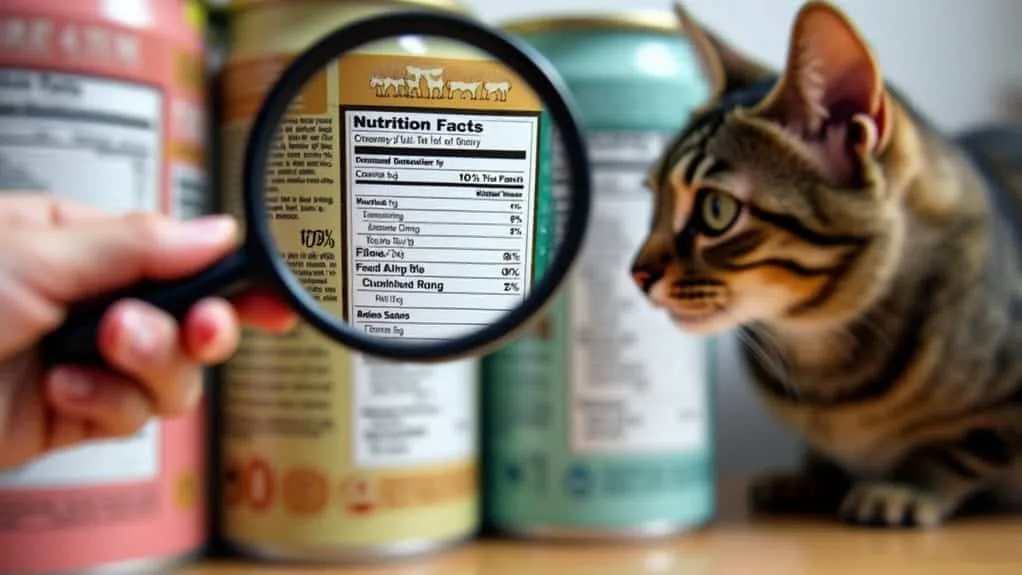
Can size is a packaging decision, not a nutritional one. Two brands can both sell 5.5-ounce cans, yet one contains 160 calories while the other has 250. If you feed “one can a day” without checking, you could be underfeeding or overfeeding by nearly 40%.
Source: Bing (Web (fair-use with source credit))
Here’s what to look for on every label you buy:
- Kcal per can: This is the most direct number. It tells you exactly how many calories are in that specific can.
- Kcal per kilogram: This is the calorie density. It’s more useful when comparing different foods on equal footing.
- Kcal per ounce: Some brands list this. It makes portion math significantly easier.
The AAFCO statement on the label tells you if the food is “complete and balanced” for a specific life stage. That’s your baseline for safety. But it doesn’t tell you how much to feed.
That’s on you.
Let’s look at a quick example. Brand A might have 45 kcal per ounce. Brand B might have 35 kcal per ounce.
For a cat needing 250 calories a day, Brand A requires about 5.5 ounces, while Brand B needs closer to 7 ounces. Same cat, different amounts, based entirely on the food you choose.
If you’re dealing with a picky eater or switching brands, tracking calories instead of volume makes everything easier. You can compare apples to apples and keep your cat’s intake consistent. Need a general baseline for cans per day?
Our guide on canned food portions per day covers the starting points in more detail.
Calculate the Correct Baseline: A Step-by-Step Process
Here’s where we get into real numbers. Veterinarians and board-certified nutritionists use a standard formula to estimate how many calories a cat needs. It’s called the Resting Energy Requirement (RER).
The formula is: 70 x (body weight in kilograms) ^ 0.75
That sounds like algebra, but it’s simple math. And once you have the RER, you multiply it by a factor based on your cat’s specific situation. That gives you the daily calorie target.
Step 1: Weigh your cat accurately.
Use a baby scale or a kitchen scale. Weigh yourself, hold the cat, and subtract. You need the weight in kilograms for the formula, so divide pounds by 2.2.
Step 2: Calculate the RER.
Here’s a quick reference so you don’t need a scientific calculator:
| Cat’s Weight (lbs) | Weight (kg) | RER (kcal/day) |
|---|---|---|
| 8 lbs | 3.6 kg | ~175 kcal |
| 10 lbs | 4.5 kg | ~205 kcal |
| 12 lbs | 5.4 kg | ~235 kcal |
| 14 lbs | 6.4 kg | ~265 kcal |
Step 3: Apply the activity factor.
- Neutered adult cat: multiply RER by 1.2
- Active or outdoor cat: multiply by 1.5
- Overweight cat: use RER (no multiplier) for weight loss
- Kitten (under 12 months): multiply by 2.5 to 3.0
So for a 10-pound neutered indoor cat, the RER is 205. Multiply by 1.2, and you get roughly 246 calories per day.
Step 4: Convert calories to ounces.
Look at your food’s kcal per ounce. Divide your cat’s daily calorie target by that number. A 246-calorie target with food at 45 kcal per ounce means about 5.5 ounces per day.
That’s exactly one 5.5-ounce can.
A 12-pound neutered cat needs about 282 calories. At 40 kcal per ounce, that’s just over 7 ounces daily. The math always comes back to calories, not can count.
Adjusting for Life Stage and Health Status
The baseline calculation works for a healthy adult cat. But different life stages throw a wrench into the system, and you need to adjust accordingly.
Kittens (0 to 12 months)
Kittens grow fast. They need two to three times the calories per pound that adult cats do. A 2-pound kitten might need 200 to 250 calories a day.
That’s a lot of food in a tiny stomach, which is why kittens eat small meals frequently, often four or more times a day. Feed kitten-specific food until 12 months.
Senior cats (10 years and up)
Older cats often have lower calorie needs due to reduced activity. But they also have trouble digesting fat and protein efficiently. They need highly digestible, protein-rich food, and the portion size should be based on maintaining muscle mass, not just calorie cutting.
Monitor weight closely. If they lose weight, increase the portion by 10%.
Overweight cats
If your cat needs to lose weight, don’t just cut food drastically. That causes rapid weight loss, which is dangerous for cats. Aim for a 1% to 2% body weight loss per week.
That’s only about 0.15 to 0.3 pounds per week for a 15-pound cat. Reduce the calorie target to the RER without the activity multiplier, and use a food specifically formulated for weight management. You might also want to read our piece on why cats always seem hungry before you get too strict, since constant begging can signal a medical issue needing a vet’s attention.
Underweight or recovering cats
Sometimes cats need to gain weight. Post-surgery, during illness, or after a period of poor appetite, they need a calorie surplus. Increase the portion by 10% to 20% and consider a calorie-dense recovery food, often sold as “critical care” formulas from brands like Royal Canin or Hill’s.
As of 2026, most vet clinics carry these.
Whatever the life stage, weigh your cat every two weeks. Track the trend, not the daily fluctuation. If the weight is moving in the wrong direction, adjust the portion by 10% and monitor again.
Small, consistent corrections beat dramatic changes every time. And if your cat has a diagnosed condition like diabetes or kidney disease, don’t adjust portions on your own. Work with your vet to build a calorie plan that fits the treatment protocol.