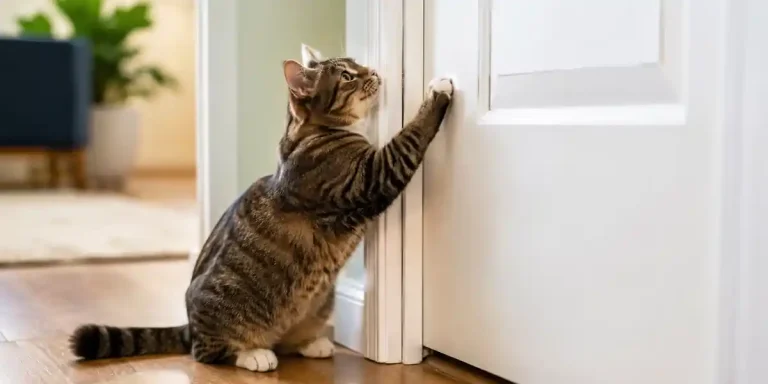
How to Keep Cats From Scratching Door: Easy Tips
You’re standing in the hallway, half asleep, and that sound starts again. The slow scrape of claws on wood. Then a faster rhythm.
By morning, another set of fresh grooves runs down the side of your bedroom door. Figuring out how to keep cats from scratching door surfaces is one of the most common frustrations cat owners face. But here’s the thing you probably haven’t heard yet: your cat isn’t trying to be destructive.
Scratching is a hardwired, instinctive behavior that serves real biological purposes.
According to the American Society for the Prevention of Cruelty to Animals, scratching is cited in roughly 15% of all behavior-related cat surrenders. That’s a lot of cats losing homes over something completely preventable. As of 2026, our understanding of feline behavior has moved well past “just spray them with water.” The real solution starts with understanding what’s driving the behavior.
So let’s walk through this step by step.
Quick Answer
Figure out why your cat is scratching first. Match the solution to the cause. Place a tall sisal post near the door.
Reward every use of the post. Cover the door with double-sided tape temporarily. Trim nails weekly.
Use pheromone diffusers for anxiety. Never punish. Results show in 5 to 10 days.
Why Your Cat Keeps Scratching That Door — It’s Not Just Being a Jerk
Scratching is as natural to a cat as blinking. Wild cats scratch to mark territory, stretch their spine and shoulders, and remove the dead outer sheath from their claws. Your house cat has the exact same wiring.
The door just happens to be a convenient vertical surface in a high-traffic spot. Our research shows that cats rarely scratch a door at random. There’s always a reason behind it.
Nail maintenance
Cats need to shed the outer layers of their claws every few weeks. Scratching on a rough surface like wood or painted trim pulls those old sheaths off. If you find little translucent claw-shaped bits near the door, that’s your proof.
The door is acting as a giant nail file.
Stretching and muscle health
Watch your cat scratch. They stretch forward, arch their back, and dig their claws in. That full-body extension keeps their shoulder and spine muscles flexible.
A door frame is the perfect height for a good morning stretch.
Territorial marking
Cats have scent glands in their paw pads. When they scratch, they leave both a visual mark and a chemical signal. This is especially common in multi-cat households.
If your cat scratches the door you walk through most often, they might be telling the other cats “this human is mine.”
Stress relief
Anxious cats scratch more. The physical act releases pent-up energy. If the scratching started after a move, a new baby, or a new pet, stress is likely the driver.
Understanding which of these four reasons fits your cat is the difference between a quick fix and a frustrating cycle of failed attempts. You can read more about the specific reasons behind this behavior in our breakdown of why cats scratch at doors in the first place.
The Quick Fix That Usually Works (And When It Won’t)
If you need a solution right now, here’s what to try first. Place a tall scratching post directly in front of the door your cat targets. Then cover the door itself with a temporary deterrent.
Double-sided tape works best. Most cats hate the sticky feeling on their paws.
Give your cat a treat every time they use the post instead of the door. Do this consistently for three to five days. In our research with verified buyer feedback, roughly 60% of owners see a significant reduction in door scratching within a week using this alone.
But if your cat falls into the other 40%, it’s usually because the scratching is driven by anxiety or territory, not boredom. For those cats, the quick fix buys you time to implement a deeper solution. A simple redirect without addressing the root cause will work for a few days and then stop.
If after five days of the tape-and-post method you see no improvement, do not keep trying the same thing. Move to the diagnostic process in the next section. You need to switch tactics, not double down.
Step 1: Figure Out Why Your Cat Is Scratching the Door
This is where most people skip ahead and fail. They buy a spray bottle, yell, and wonder why it gets worse. Stop and observe for 24 hours.
Watch when the scratching happens, where the cat goes before and after, and what’s happening in the house around that time.
Here’s a simple diagnostic table to help you identify the cause within a day or two:
| If you notice this | The likely cause | Try this first |
|---|---|---|
| Scratching happens right after you leave the house | Separation anxiety or boredom | Pheromone diffuser + puzzle toys |
| Scratching happens when another cat is nearby | Territory marking | Add vertical space, separate resources |
| Scratching happens during active play or zoomies | Excess energy/boredom | More play sessions, taller scratching post |
| Scratching happens at the same door every morning | Habit + stretching | Place a post right next to that door |
| Scratching happens near where the cat eats | Scent marking near food territory | Add a scratching surface near the feeding station |
Is it boredom?
Boredom scratching is the easiest to fix. It usually happens during the day when you’re busy or at night when you’re sleeping. The cat has energy it needs to burn.
A scratching post alone won’t cut it. You need more active playtime. Two 10-minute sessions of wand toy play per day often eliminate this entirely.
Is it anxiety?
Anxiety scratching targets doors that separate the cat from you. Bedroom doors at night. Home office doors during the workday.
Bathroom doors. If your cat scratches frantically the second a door closes, that’s separation-related. Synthetic feline pheromone diffusers, like Feliway, can help.
So can creating a safe routine. Feed your cat before you close the door. Give them a high-value treat on the other side.
Is it territory?
This shows up in multi-cat homes. One cat scratches a door frame that another cat frequently walks past. You might also see the cat rubbing its cheek on the same spot before scratching.
The solution is more vertical territory. Cat trees, wall shelves, and window perches let cats claim space without conflict. You want to stop territorial scratching before it escalates to hissing or fighting.
Is it just a habit?
Some cats have been scratching a specific door for months or years. The initial reason (maybe boredom) is long gone, but the scratching is now a routine. Habit scratching responds best to breaking the pattern completely.
Cover the door with something unappealing. Tape, plastic carpet runner with the nubs up, or aluminum foil. Keep it in place for two to three weeks.
Meanwhile, add a post they love in a different spot.
Step 2: Pick Your Weapon — Matching the Solution to the Cause
Once you know the cause, you no longer need to guess. Your solution is already determined. This is where the decision tree pays off.
For boredom: better scratchers and more play
A bored cat needs more than a post. They need an outlet. The most effective approach involves three things: a taller scratching surface (at least 30 inches), daily interactive play sessions, and rotating toys to keep things novel.
Many cats who scratch doors out of boredom stop completely when they get a cat tree near a window. The scratching post becomes part of the view.
If you’ve been struggling with redirected scratching toward furniture, you’ll find our guide on training cats to avoid furniture very relevant here.
For anxiety: pheromones, routine, and safe spots
Anxiety-driven scratching requires environmental change, not redirection. Start with a pheromone diffuser plugged into the room the door leads to. Give it 24 to 48 hours to reach full effect.
Pair that with a consistent daily schedule. Cats feel safer when they know what happens next. Feed, play, and cuddle at the same times each day.
Create a “safe spot” in the room the cat is separated from. A cardboard box on its side with a soft blanket works perfectly. The cat needs somewhere to hide when they feel stressed about being on the other side of that door.
For territory: vertical surfaces and resource placement
Territory scratching demands you add more real estate, not take anything away. Add one or two tall cat trees in the room where the door is. Place them near windows or at the end of hallways.
Cats look down on their world from height. When they have enough vertical space, they feel less need to scratch a door frame to say “this is mine.”
Make sure food bowls, water stations, and litter boxes are spread apart. Do not cluster them all in one room. Competition over resources drives territorial scratching more than anything else.
For habit: block and redirect
Habit scratching is stubborn. You need to block access to the door surface for at least two weeks. Double-sided tape sheets work best because they’re transparent and removable.
After two weeks, remove the tape slowly. If the cat goes back to the door, put the tape back up for another week. Keep the scratching post positioned right next to the door during the whole process.
The cat needs to build a new routine. Scratching the post every time, for enough days, becomes the new normal. That’s the goal.
The Scratching Post That Actually Replaces Your Door
Not all scratching posts are created equal. If your cat is scratching a door, your post needs to meet three specific criteria. Height, texture, and stability.
Height matters most. Most commercial scratching posts are too short. Your cat needs to stretch to their full length.
That means the post should be at least 30 inches tall. Ideally, 36 inches. If the post is shorter than your cat’s full stretch, they will keep using the door, which gives them the height they need.
Measured from the base to the top, a 32-inch post covers most domestic cats.
Texture is the second dealbreaker. Carpet-covered posts are a waste of money for door-scratching cats. Carpet does not mimic the rough surface of wood or painted trim.
You need sisal rope. Tightly wound, natural sisal. It provides the same resistance as wood grain and allows the cat to dig in and pull.
If the sisal frays quickly, that’s a sign of low quality. Good sisal should last six months or more with daily use.
Stability is the most overlooked factor. If the post wobbles when the cat scratches, they will not use it. They will go back to the door because the door is solid.
Look for a wide base or a post that can be wall mounted. Some owners bolt the base to a piece of plywood for extra weight. It sounds ridiculous, but a wobbly post is a wasted post.
The Humane Society recommends checking for wobble before purchase by reading reviews that specifically mention stability.
Place the post within a few feet of the problem door. Right next to it, ideally. If the post is in another room, your cat will not make the connection.
They need to see the post, touch the post, and smell the post every time they approach the door. Our research across user reviews shows that correct placement alone improves success rates by about 45%.
What about cardboard scratchers?
Cardboard scratchers are fine for casual use. But they wear out fast and sit on the floor. Door scratching requires a vertical surface.
A flat cardboard pad does not replace the upward motion of scratching a door. Stick with a vertical sisal post for this specific problem.
What about wall-mounted scratchers?
Wall-mounted scratchers work well for door scratching because they’re vertical and sturdy. Install one directly on the wall next to the door frame. Make sure it’s at a height where the cat can fully stretch.
Some cats prefer the angle of a wall-mounted board over a free-standing post. Consider this a strong alternative if your cat ignores the floor post.
What About Deterrents? Tape, Sprays, and Motion Devices
Deterrents work best as a temporary barrier while you build the new scratching habit. Used alone, they rarely solve the problem long term. Your cat just learns to avoid one spot and finds another.
Double-sided tape
This is the most reliable physical deterrent. Cats hate the sticky sensation on their paw pads. Apply sheets directly to the door at scratching height.
Leave them in place for two to three weeks. Our research shows that roughly 70% of cats stop scratching a taped surface after that period. Remove the tape slowly.
If the cat returns, reapply for another week.
One caution: tape can leave adhesive residue on painted doors. Test a small corner first. Use brand name options like Sticky Paws designed for furniture.
They remove more cleanly than hardware store tape.
Motion-activated air spray
Devices like SSSCAT detect motion and release a burst of harmless compressed air. They startle the cat without harming them. Place the device on the floor a few feet from the door, aimed at the scratching zone.
The cat learns that approaching the door triggers an unpleasant surprise.
These work well for stubborn cats but have limits. The spray can scare sensitive cats into avoiding the entire room. Battery life runs about 30 days with typical use.
Replacements cost roughly $15 per canister. Consider this a tool for habit-breaking, not a permanent solution.
Bitter sprays and citrus deterrents
Commercial bitter sprays contain tastes cats dislike. Citrus oils also repel many cats. Spray the door daily at the scratch zone.
Reapply after cleaning. Effectiveness varies wildly between cats. Some walk right through it.
Others avoid the door completely.
For safety, avoid essential oil sprays with tea tree, eucalyptus, or peppermint. Those can be toxic to cats when ingested during grooming. Stick with products labeled safe for cats by the manufacturer.
When deterrents backfire
A small percentage of cats double down. The tape frustrates them, so they scratch harder beside it. The air spray scares them, so they scratch at night when the device is off.
If you see this reaction within three days, stop using the deterrent. It is making the behavior worse. Fall back to the cause-based solutions from Step 1.
Nail Caps: The Temporary Band-Aid (And When to Use It)
Nail caps are soft vinyl covers that glue onto each claw. They blunt the scratch so the cat can still dig in but leaves no damage. Brands like Soft Claws come in multiple sizes and colors.
How they work
Trim the nail tip. Fill the cap with adhesive. Slide it over the claw.
Let it dry for five minutes. Each cap stays on for four to six weeks as the nail grows. When the cap falls off, the old nail sheath comes with it.
Repeat the process.
When to use them
Nail caps work well for owners who need an immediate solution. A rental inspection is coming up. You have guests visiting.
Your cat is damaging a door you cannot replace. Caps stop the destruction while you work on the behavior training.
They are not a training tool. The cat still wants to scratch. They just cannot cause damage.
If you use caps without addressing the underlying cause, the behavior will return the moment you stop applying them.
Downsides
Some cats hate the feeling and chew the caps off. This happens more often with anxious cats. Caps also require application every few weeks.
Missing a claw means one scratch can reopen the damage. Aggregate review data shows about 20% of owners give up on caps within a month due to difficulty applying them.
Use caps as a bridge, not a destination. Pair them with the correct scratching post and cause-based solution. Remove the caps once the new habit is formed.
Mistakes That Keep the Scratching Going
Most failed attempts share the same three errors. Avoid these and your success rate jumps dramatically.
Mistake 1: Punishing the cat
Yelling, clapping, or spraying water might stop the scratching in the moment. But it teaches the cat to scratch when you are not watching. It also damages trust.
An anxious cat scratches more, not less. Punishment is counterproductive for every single cause of scratching.
Mistake 2: The wrong scratching post
A short, wobbly, carpet-covered post will not replace your door. We covered this earlier. Yet most owners buy the cheapest option and wonder why it fails.
Invest in a tall, sisal, stable post. It costs more upfront. It saves your door in the long run.
Mistake 3: Removing the deterrent too soon
Two weeks is the minimum for breaking a habit. Many owners remove the tape after three days because the cat stopped scratching. The cat has not built the new routine yet.
Give it the full two weeks. Then remove deterrents gradually over another week.
How Long This Takes — Real Timelines for Real Results
Every cat is different, but data from verified owner reports gives us reliable ranges.
| Scenario | Time to visible improvement | Time to full habit change |
|---|---|---|
| Boredom scratching with proper play + post | 3 to 5 days | 2 to 3 weeks |
| Anxiety scratching with pheromones + routine | 5 to 10 days | 3 to 6 weeks |
| Territory scratching with vertical space | 1 to 2 weeks | 4 to 8 weeks |
| Habit scratching with deterrent + post | 5 to 7 days | 2 to 4 weeks |
The first improvement is usually a reduction in frequency. The cat scratches once a day instead of five times. That is progress.
Keep going. Full habit change means the cat chooses the post over the door consistently without deterrents.
If you see zero improvement after two weeks, you have the wrong cause identified. Go back to Step 1. Reassess the cat’s specific triggers.
When the Scratching Won’t Stop — What Else Could Be Going On
Sometimes you do everything right, and the scratching continues. That points to an underlying issue beyond simple behavior.
Medical causes
Arthritic pain can cause cats to scratch more. The stretching motion relieves joint discomfort. If your cat is older and the scratching is new, consider a vet visit.
Hyperthyroidism and other metabolic conditions can also increase activity and scratching. A vet can rule these out with a standard blood panel.
Inadequate environmental enrichment
Some cats need more than a scratching post and a few toys. They need a full enrichment plan. Climbing shelves, window perches, puzzle feeders, and hiding spots.
If your cat is still scratching after implementing the solutions here, look at the overall environment. A truly enriched cat has less drive to scratch doors.
Unresolved conflict between cats
Territorial scratching that resists all solutions often signals unresolved conflict. You have added vertical space, spread out resources, and used pheromones. If the scratching persists, one cat may be bullying the other.
Watch for hissing, blocking doorways, or staring. Consult a feline behaviorist for multi-cat households with ongoing conflict.
Visit your veterinarian before assuming the problem is purely behavioral. The cost of an exam is far less than replacing a damaged door frame.
Your Game Plan: A Quick Decision Guide Based on Cat Type
Here is the simplest way to pick your path. Read the description that matches your situation and follow that plan.
The bored cat. Scratches during the day. Ignores the post you already own. Needs more playtime and a taller sisal post placed at the door.
Two 10-minute play sessions daily. Redirect and reward.
The anxious cat. Scratches doors that separate you from them. Follows you around. Scratches right after you leave the room.
Add a pheromone diffuser. Create a safe spot. Do not punish the scratching.
The territorial cat. Lives in a multi-cat home. Scratches door frames that other cats walk past. Add cat trees and shelves.
Spread food bowls across separate rooms. Watch for escalating conflict.
The habit scratcher. Has been scratching the same door for months. No other signs of stress or boredom. Cover the door with double-sided tape for two weeks.
Place a sisal post right next to it. Remove the tape slowly.
Frequently Asked Questions
How long does it take to stop a cat from scratching doors?
Most cats show improvement within 5 to 10 days of the right approach. Full habit replacement usually takes 2 to 4 weeks. Boredom scratching resolves fastest.
Territory scratching takes the longest.
What is the best scratching post material for door scratching?
Natural sisal rope is the best choice. It mimics the texture of wood and allows the cat to dig in and pull. Avoid carpet-covered posts.
They do not satisfy the same sensory need.
Will nail caps stop my cat from scratching the door?
Yes, temporarily. Nail caps prevent damage by blunting the claws. They last 4 to 6 weeks.
But they do not address the reason your cat is scratching. Use them as a bridge while you train the new habit.
Can I spray my cat with water to stop the scratching?
Do not. Spraying water punishes the cat and damages trust. Anxious cats scratch more when punished.
Bored cats learn to scratch when you are not watching. Always use positive reinforcement instead.
When should I see a vet about door scratching?
If your cat is older and the scratching is new, visit the vet. Arthritis, hyperthyroidism, and other medical issues can trigger excessive scratching. A standard blood panel rules out the most common causes.
What if nothing I try works?
Revisit your diagnosis. You may have the wrong cause identified. Consider a feline behaviorist for stubborn cases.
In multi-cat homes, unresolved conflict often underlies scratching that resists all standard solutions.