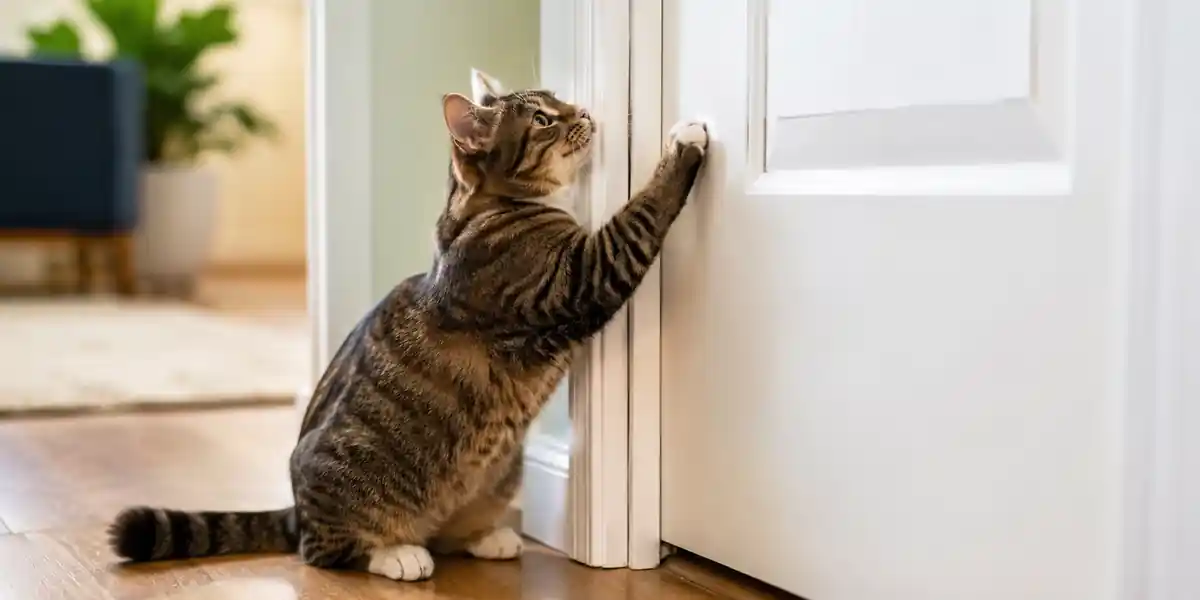
Why Does My Cat Hate Closed Doors? Causes Explained
You close the bedroom door and hear it. The frantic scratching starts at the base, followed by a pitiful yowl. If you’ve ever wondered “Why does my cat hate closed doors,” you’re not alone.
This is one of the most common behavioral complaints cat owners bring to veterinarians, and it’s rarely about spite.
Research from the Cornell Feline Health Center indicates that up to 40 percent of domestic cats show signs of barrier-related distress when denied access to a room or person. The triggers are usually simple and fixable once you understand what’s actually driving the behavior. Let’s walk through the reasons and figure out which one fits your situation.
Quick Answer
Your cat hates closed doors because they disrupt territory, block access to resources, or trigger separation anxiety. Cats rely on scent continuity and visual control over their environment. A closed door breaks both.
The behavior is normally not malicious. It is a stress response to losing access, control, or connection.
The Problem: Why Your Cat Loses It Over a Closed Door
The scene is almost comical until it isn’t. A normally calm cat turns into a scratch-howl-paw machine the second a door clicks shut. To understand why, you have to think like a cat for a minute.
Cats are territorial animals. They map their world through scent, sound, and sight. A closed door doesn’t just block a room.
It blocks a whole set of sensory inputs your cat relies on to feel safe. That room smells like you. It has your cat’s own scent marks on the furniture and door frames.
When that door shuts, your cat loses access to a piece of its territory.
There is also the social piece. Domestic cats, especially ones raised indoors, form strong attachments to their humans. They want to know where you are at all times.
A closed door represents uncertainty. You are right there, but you are unreachable. That is frustrating for a creature that thrives on routine and predictability.
As of 2026, behaviorists have identified four primary drivers for this reaction. We will go through each one so you can match it to your cat’s specific behavior.
The 4 Most Common Reasons (With How to Tell Which Is Yours)
Reason 1: FOMO and Social Separation
Fear of missing out is real for cats. They want to be part of whatever is happening on the other side of that door. If you are in the bathroom, your cat assumes there is something interesting in there.
If you close the office door, your cat assumes you are having fun without them.
How to tell this is your cat: The reaction happens immediately when the door closes and involves persistent meowing, pawing at the gap under the door, or sitting and staring at the closed door for long periods. The cat generally stops the second the door opens and looks unbothered. It wants access to you, not the room itself.
Reason 2: Territory and Scent Disruption
Cats have scent glands on their cheeks, paws, and flanks. They mark their territory by rubbing against surfaces and scratching. A closed door interrupts the natural scent flow through your home.
The doorway is a major communication hub for your cat. When the door shuts, the cat can’t complete its scent circuit.
How to tell this is your cat: The cat scratches specifically at the door frame or the door itself, not just the gap underneath. It may also rub its face against the closed door repeatedly or spray urine near the door threshold. This is more common in multi-cat households where territorial boundaries matter more.
Reason 3: Resource Access Anxiety
This one is practical and often overlooked. Your cat may be reacting to a closed door because something important is behind it. The litter box.
The food bowl. A favorite sunny window perch. A cozy bed.
If you have recently moved a resource behind a door your cat previously had open access to, the reaction makes perfect sense.
How to tell this is your cat: The cat only reacts to certain doors, not all of them. It scratches hardest at doors leading to the laundry room, the spare bedroom with the cat tree, or the bathroom where you keep the litter box. If you open the door and the cat walks straight to a specific spot, you have your answer.
Reason 4: Past Negative Associations
Some cats learn that closed doors predict bad things. If you used to close a door when you left the house and your cat associates that with being alone for hours, the door itself becomes a trigger. The same applies if a closed door once trapped the cat in a room during a stressful event like a loud noise or another cat confrontation.
How to tell this is your cat: The reaction is more intense than a typical scratching session. You may see flattened ears, dilated pupils, or excessive vocalization that sounds distressed rather than demanding. The cat may also avoid walking near that particular door when it is open, suggesting a lingering negative memory.
The Decision Tree: Diagnose Your Cat’s Door Drama
Answer these questions in order. Each one narrows down the cause.
Question 1: When Does the Reaction Happen?
- Immediately after the door closes and stops when it opens → Likely social separation or FOMO.
- Persists for minutes after the door closes, even when you are quiet → Likely territory or resource related.
- Only happens when you leave the house → Likely anxiety or past negative association.
Question 2: Which Room Is Behind the Door?
- Bathroom or bedroom where you spend time → Social separation is the most probable cause.
- Laundry room, pantry, or utility room → Resource access. Check what is in there.
- Spare room or guest room → Territory disruption or a hidden resource like a mouse or insect.
- Any room equally → Generalized anxiety or territorial insecurity.
Question 3: What Does Your Cat Actually Do?
- Paws under the gap and meows → Wants access to you.
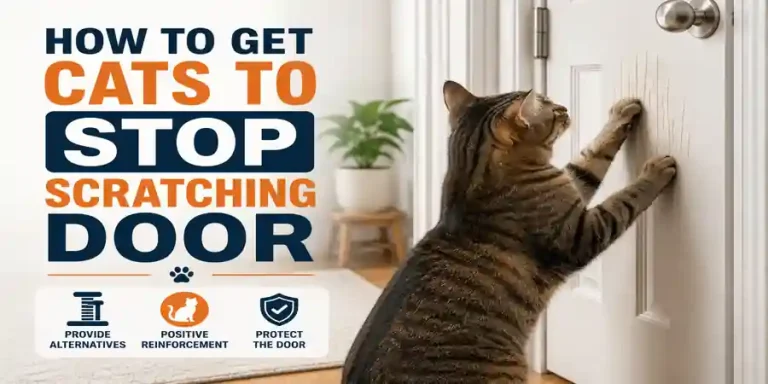
- Scratches the door surface and frame repeatedly → Scent marking and territory assertion.
- Yowls loudly and paces → Distress, possibly anxiety or past trauma.
- Urinates or sprays near the door → Serious territory or stress issue. Consider a vet visit.
Question 4: Is This a Multi-Cat Household Issue?
If you have more than one cat, the dynamic shifts. A closed door can trap resources on one side, creating competition. One cat may guard the door while the other cat scratches to get in.
This is not about the door itself. It is about resource control between cats.
What to look for: Watch which cat reacts and which cat is on the other side. If the door separates two cats that do not get along, the scratching may be about intimidation or guarding, not access.
Question 5: Has Anything Changed Recently?
Cats are creatures of habit. A new piece of furniture in a room. A new pet.
A change in your work schedule. Rearranged furniture on the other side of the door. Any of these can make a previously fine cat suddenly hate a closed door.
The change shifts the cat’s mental map of the space.
What to look for: Think back to when the behavior started. What changed in that week? The answer is often sitting right there.