What Is How Much Food Should a 12 Pound Cat Eat
If you've ever stood over your cat's bowl wondering whether that scoop was too big or too small, you're not alone. The question of how much food should a 12 pound cat eat is one of the most common feeding dilemmas owners face, and honestly, it's more complicated than the back of the kibble bag suggests. Your cat's daily calories depend on her unique metabolism, activity level, body condition, and the specific food you're pouring, not just her weight on the scale.
Here's what the research consistently shows: most healthy adult indoor cats need roughly 200 to 260 calories per day, which translates to about 1/2 to 3/4 cup of standard dry kibble or 1.5 to 2.5 cans of wet food, depending on the brand's calorie density. As of 2026, veterinary nutrition guidelines from institutions like Cornell's Feline Health Center emphasize that these numbers are starting points, not prescriptions. Your cat's ideal portion could sit slightly above or below that range, which is exactly why we're going to break down the math, the labels, and the real-world factors together.
Image source: Bing (Web (fair-use with source credit))
Quick Answer
A healthy 12-pound indoor cat typically needs 200 to 260 calories daily. That equals roughly 1/2 to 3/4 cup of dry food or 1.5 to 2.5 cans of wet food. Always check the kcal content on your food's label.
Adjust portions based on your cat's body condition, not just weight. When in doubt, ask your veterinarian.
Why a One-Size-Fits-All Number Is Dangerous
The feeding chart printed on most cat food bags is a starting point, not a prescription. Those recommendations are calculated for the average cat, but there's no such thing as an average cat in your living room. Your 12-pound feline might be a lean, athletic hunter who patrols the neighborhood, or she could be a couch potato who only moves between sunbeams.
Those two cats need wildly different amounts of food.
Here's the uncomfortable truth: those bag guidelines tend to overestimate portion sizes. They're designed to ensure no cat starves, which means they err on the side of too much. For a sedentary indoor cat, following the bag's "for 10-15 pounds" column can easily push her into obesity within a year.
That extra weight isn't cosmetic, it's a direct contributor to diabetes, arthritis, and a shortened lifespan.
The scale alone doesn't tell you the full story either. A 12-pound Maine Coon with a large frame can be perfectly lean, while a 12-pound domestic shorthair could be carrying excess fat. Veterinary research consistently shows that body condition scoring provides far more useful information than weight alone.
This is why the safe approach always starts with understanding your cat's physical makeup before you measure out a single scoop.
The 5 Factors That Change How Much to Feed
Your cat's daily portion isn't based on weight alone. Every cat has a unique metabolic profile, and these five factors shift the numbers more than most owners realize.
Neuter status. This one is huge. Neutered or spayed cats have approximately 20 to 30 percent lower energy requirements than intact cats. Hormones played a role in metabolism, and once they're gone, the calorie burn drops.
If your 12-pound cat is fixed, she likely needs less food than the bag suggests for her weight.
Activity level. An indoor-only cat who naps 18 hours a day needs around 20 percent fewer calories than an outdoor cat who patrols her territory daily. If your cat gets regular play sessions and uses a cat wheel, she can eat toward the higher end of the range. If she mostly sleeps, lean toward the lower end.
Age. Cats past age seven often experience a natural slowdown in metabolism. Senior cats may need fewer calories to maintain weight, though muscle loss can complicate things. Regular veterinary checkups help catch these shifts before they become problems.
Body condition score. This is the most important factor, and we're covering it in depth below. A cat at an ideal BCS can maintain her current calorie intake. An overweight cat needs a gradual reduction, while an underweight cat needs more.
Food caloric density. Dry food typically packs 350 to 500 kcal per cup, while wet food ranges from 70 to 150 kcal per 3-ounce can. That means your "one cup" of one brand could be completely different from another brand's "one cup" in terms of actual calories. Always check the label for kcal per cup or can.
Understanding Body Condition Score (BCS) Before You Measure Food
Body Condition Score is a simple at-home assessment that veterinarians use to evaluate whether a cat is underweight, ideal, or overweight. The scale runs from 1 to 9, with 4 and 5 being the sweet spot. A cat at BCS 4 to 5 has a visible waist when viewed from above, ribs that are easily felt but not prominently visible through the coat, and a slight abdominal tuck when viewed from the side.
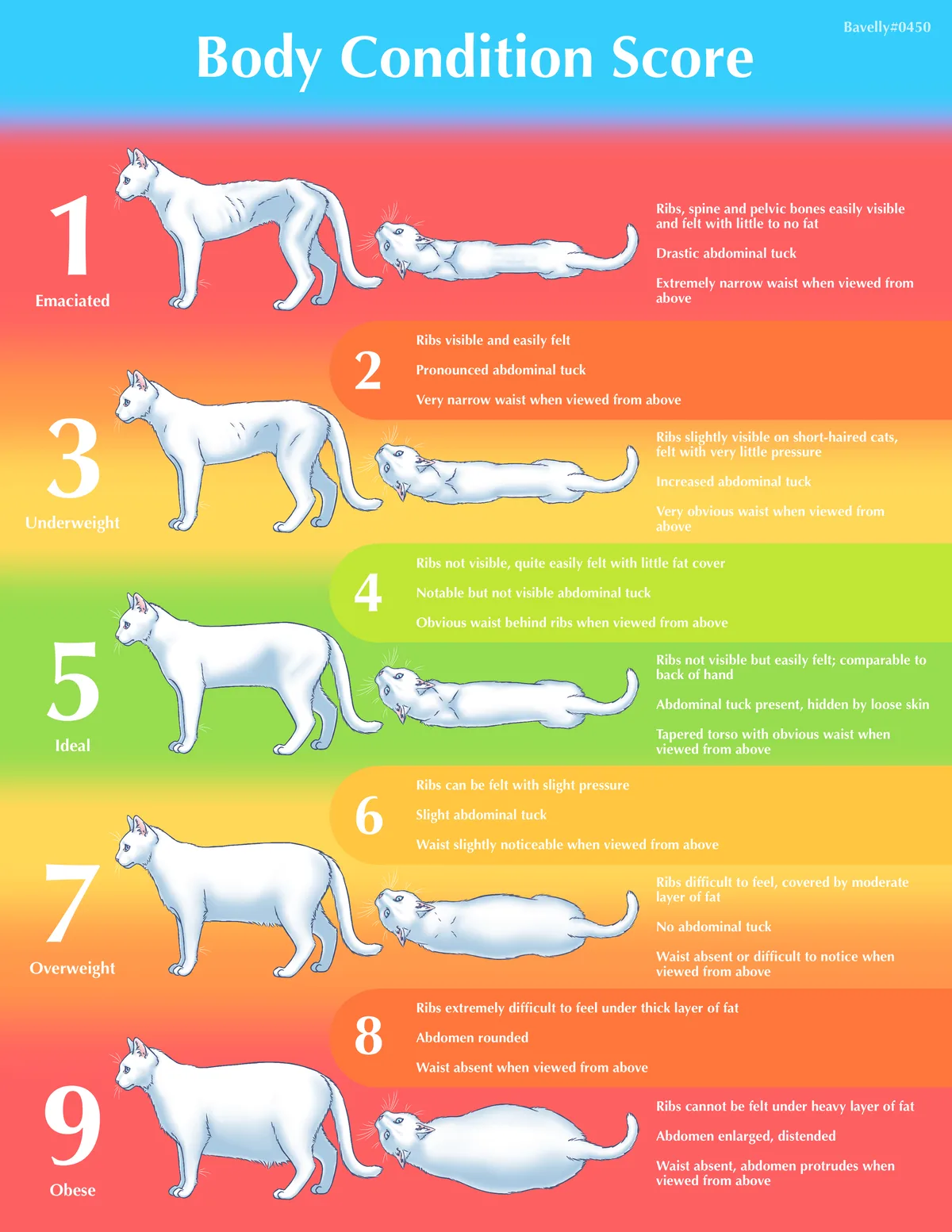
Image source: Bing (Web (fair-use with source credit))
Here's how to check your 12-pound cat at home. Run your hands along her ribcage. You should feel each rib with light pressure, like running your fingers over the back of your hand.
If you can't feel ribs without pressing firmly, she's likely overweight. If the ribs are visibly protruding through her fur, she's underweight. Look at her from above while she stands.
An ideal cat has a visible hourglass shape. From the side, she should have a slight tuck where her belly meets her hind legs.
If your cat scores a 6 or higher, she needs fewer calories than her weight alone suggests. A 12-pound cat at BCS 6 might actually be closer to an ideal weight of 10 pounds, which means her portions should align with a 10-pound cat's needs. This mismatch between actual weight and ideal weight is why so many cats slowly gain weight even when owners follow the bag directions perfectly.
Calories In, Calories Out: How to Calculate Your Cat's Needs
The math behind feline nutrition isn't as scary as it sounds. Veterinarians use a two-step process to calculate daily energy requirements, and you can do it at home with a phone calculator in under two minutes.
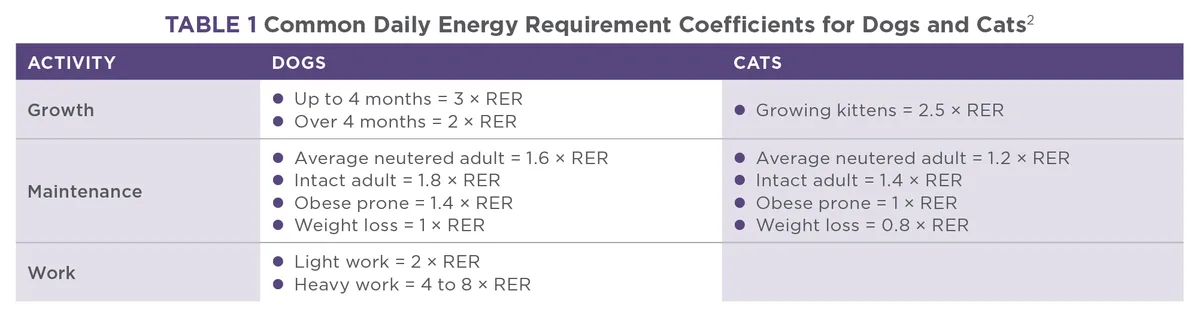
Image source: Bing (Web (fair-use with source credit))
First, calculate the Resting Energy Requirement (RER). This is the number of calories your cat needs just to exist, to breathe, pump blood, and maintain body temperature. The formula is 70 times the body weight in kilograms to the 0.75 power.
For a 12-pound cat, that's about 5.4 kilograms. The math works out to roughly 240 calories per day for maintenance.
Then you apply an activity multiplier to find the Daily Energy Requirement (DER). A neutered indoor cat with average activity gets a multiplier of 1.2, which gives you about 240 calories daily. A highly active outdoor cat might get 1.4 to 1.6, pushing her closer to 340 to 380 calories.
A sedentary cat who needs to lose weight might get a multiplier of 0.8, bringing her down to around 200 calories per day.
Here's a simple breakdown:
| Cat Type | Multiplier | Daily Calories for 12 lb Cat |
|---|---|---|
| Neutered indoor, sedentary | 1.2 | ~240 kcal |
| Neutered indoor, active | 1.4 | ~280 kcal |
| Overweight, on a diet | 0.8 | ~200 kcal |
| Intact, outdoor active | 1.6 | ~320 kcal |
That 240-calorie baseline for a typical neutered indoor cat is remarkably consistent across veterinary sources. It aligns with the National Research Council's nutrient recommendations for adult cats. When you compare that to the average commercial dry food at around 400 kcal per cup, your 12-pound cat likely needs about 2/3 of a cup of dry food per day, split into two meals.
For wet food, the math changes completely. A standard 3-ounce can of quality wet food ranges from 70 to 120 kcal. So your cat might need anywhere from two to three cans daily, depending on the brand's specific calorie density.
This is why reading labels matters more than following generic feeding charts. If you're serving a mix of wet and dry, add the calories together from both and adjust accordingly.